Tradition, discretion and some of London’s most distinguished streets.
St James's
Few neighbourhoods in central London combine history, architecture and discretion quite like St James’s.
Positioned between Piccadilly, Green Park, Trafalgar Square and The Mall, it occupies an extraordinary part of the capital. St James’s Palace, historic private clubs, art galleries, auction houses, specialist retailers and some of London’s best known restaurants all sit within a relatively compact network of streets that has evolved over more than three centuries.
Yet there is another side to St James’s that is less immediately obvious. Residential property is comparatively scarce and often remarkably discreet, tucked above historic shopfronts, within handsome period buildings or along quieter streets close to Green Park.
For buyers and tenants looking for a genuinely central London address with history, character and a sense of privacy, it is a particularly distinctive market.
At a Glance
St James’s offers one of central London’s most unusual combinations of heritage, culture and residential exclusivity.
Architecture
Georgian townhouses, historic squares, listed period buildings, handsome terraces and carefully converted apartments.
Lifestyle
Refined and exceptionally central, with Royal Parks, restaurants, galleries, specialist shopping and some of London’s most established institutions on the doorstep.
Property
A relatively scarce market encompassing period apartments, substantial lateral homes, occasional townhouses and a smaller selection of contemporary and highly serviced residences.
A neighbourhood built around court and society
The history of St James’s is inseparable from the Royal Court.
St James’s Palace was created by Henry VIII during the sixteenth century on the site of an earlier hospital, but much of the neighbourhood we recognise today emerged following the Restoration.
During the 1660s, Henry Jermyn, Earl of St Albans, began developing St James’s Fields. St James’s Square was conceived as a prestigious residential address for nobles and courtiers associated with Charles II, becoming one of the earliest great residential squares of London’s West End. King Street, Bury Street and the surrounding network followed, establishing a street pattern which has survived remarkably intact.
During the eighteenth and nineteenth centuries, St James’s developed an identity quite unlike neighbouring districts. Coffee houses evolved into private clubs, specialist retailers established themselves around Jermyn Street and St James’s Street, while galleries and art dealers congregated around King Street and the streets surrounding St James’s Square.
That mixture of royal, residential, commercial and cultural life continues to define the neighbourhood today.
Different sides of St James’s
St James’s Place and the Green Park edge
For residential buyers, this is perhaps St James’s at its most discreet.
Running immediately behind St James’s Street towards Green Park, St James’s Place feels surprisingly secluded given its position at the heart of London. The street contains a mixture of historic houses and apartments, with some properties enjoying particularly attractive outlooks towards Green Park.
It is one of those central London addresses where the individual building can matter every bit as much as the street itself. Properties range from historic houses to substantial lateral apartments and more contemporary residences.
Nearby Park Place provides another small and relatively hidden residential enclave just off St James’s Street.
St James’s Square and King Street
St James’s Square remains the architectural centrepiece of the neighbourhood.
Originally conceived as a residential square for aristocrats and members of the Royal Court, today many of its buildings are occupied by businesses, institutions and clubs. Private homes are therefore relatively uncommon, which makes residential opportunities around the square particularly distinctive.
Immediately alongside it, King Street has a very different character. Christie’s has occupied its St James’s headquarters here since 1823, and galleries and art dealers continue to give this part of the neighbourhood a strong cultural identity.
Jermyn Street, Ryder Street and Bury Street
Jermyn Street is one of the defining streets of St James’s.
Best known for traditional shirtmakers, tailoring, specialist retailers and longstanding British businesses, it combines commercial activity at street level with residential apartments above and within the surrounding period buildings. St James's London
Ryder Street and Bury Street provide slightly quieter connections between Jermyn Street and the streets surrounding St James’s Square. This is also an important part of the local gallery district, with historic dealers sitting alongside contemporary galleries. Christie's
Residential property here is predominantly apartment based, and individual buildings can differ substantially in terms of condition, outlook, lift access, porterage and lease structure.
Pall Mall and St James’s Street
These are two of the neighbourhood’s grandest thoroughfares.
St James’s Street climbs from St James’s Palace towards Piccadilly, while Pall Mall is lined with some of London’s best known private clubs and institutional buildings.
Residential property is less dominant here than elsewhere in St James’s, but apartments do occasionally become available within period and mixed use buildings.
For buyers, the attraction is difficult to replicate elsewhere. Green Park, St James’s Park, Piccadilly, Mayfair and the West End are all within a few minutes’ walk, yet many of the smaller surrounding streets retain a surprisingly intimate character.


Eating and drinking in St James's
Food and drink has long been part of the character of St James’s, and the neighbourhood offers an unusually strong collection of established restaurants, hotel bars and newer dining destinations.
On Jermyn Street, Wiltons is one of the area’s longstanding dining institutions, while 45 Jermyn St. at Fortnum & Mason provides a more contemporary take on traditional St James’s dining and serves from breakfast into the evening. St James's London
Franco’s on Jermyn Street is another established local fixture, while the streets towards St James’s Market have introduced a broader and increasingly international selection of restaurants.
For drinks, the hotels and private clubs around St James’s have long played an important role in the area’s social life. Dukes Bar, tucked away on St James’s Place, remains one of the neighbourhood’s best known addresses.
A few of our Westminster favourites
For breakfast
45 Jermyn St. on Jermyn Street.
For dinner
Wiltons on Jermyn Street.
For a drink
Dukes Bar on St James’s Place.
Art, shopping and green space
Few residential neighbourhoods in London offer quite the same concentration of culture within such a small area.
Christie’s has operated from King Street since 1823, while Bury Street, Duke Street St James’s and the streets around St James’s Square remain home to numerous galleries and art dealers. Christie's
Jermyn Street brings a different type of heritage. Tailors, shirtmakers and specialist retailers sit alongside restaurants and galleries, while Fortnum & Mason occupies its landmark Piccadilly address at the northern edge of the neighbourhood. St James's London
Green space is equally exceptional.
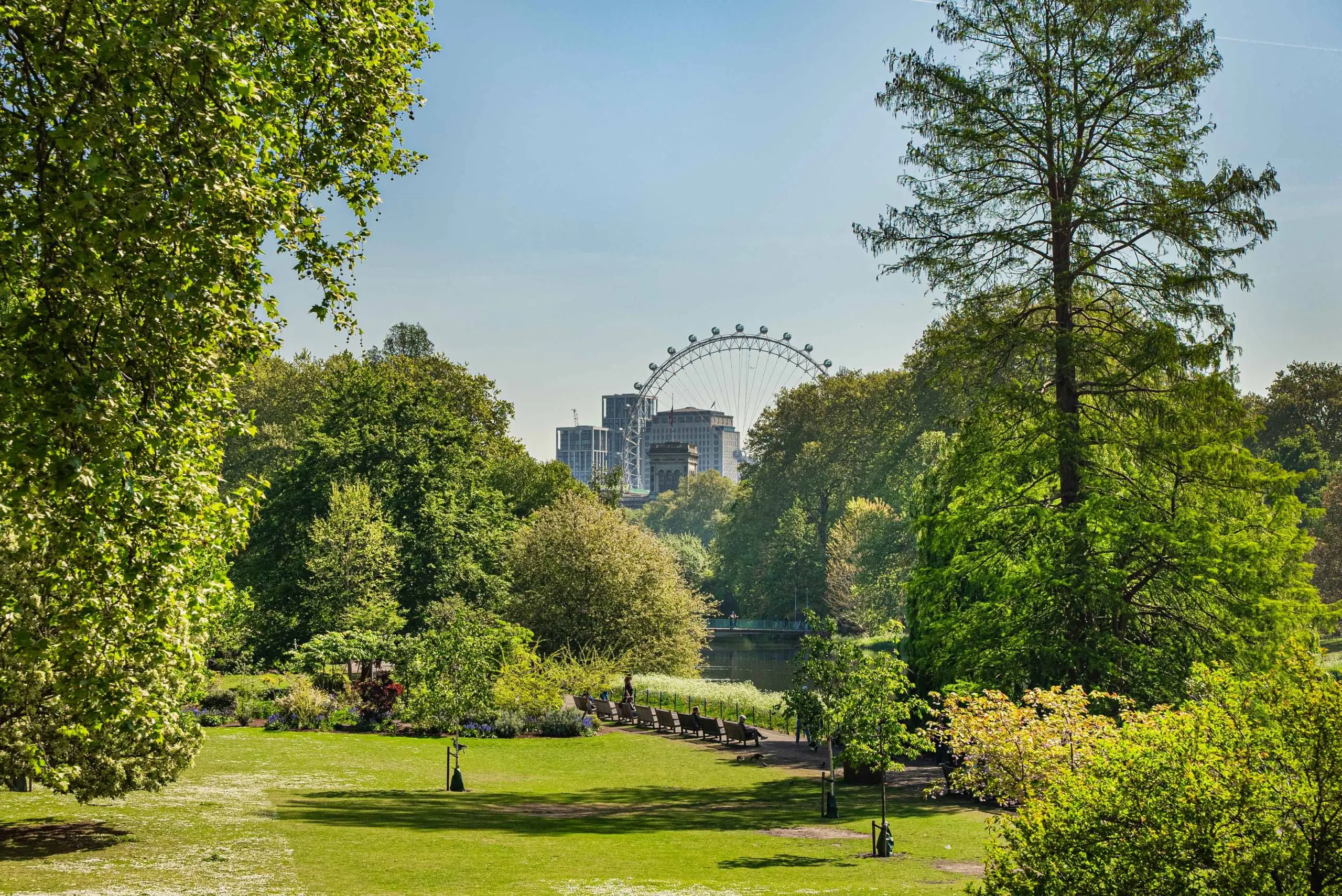
St James’s Park sits immediately to the south and is London’s oldest Royal Park, with its lake, mature landscaping and views towards Buckingham Palace, Horse Guards and Whitehall. Green Park provides another substantial open space immediately to the west. The Royal Parks
For somewhere at the very centre of London, having two Royal Parks effectively on the doorstep is one of St James’s most significant residential advantages.
Transport connections are similarly straightforward. Green Park, Piccadilly Circus and Charing Cross stations are all within easy walking distance, providing Underground and mainline connections across London and beyond.
Our view
St James’s is not a conventional residential neighbourhood, and that is a large part of its appeal.
The number of homes is relatively limited, particularly when compared with neighbouring Mayfair, Belgravia or Pimlico. Residential property is interwoven with galleries, clubs, shops, offices and historic institutions, often making the best homes considerably less obvious from the street.
It also means that there can be substantial differences between apparently similar addresses.
A historic townhouse on St James’s Place, a lateral apartment on Jermyn Street and a residence overlooking St James’s Square may be separated by only a few hundred metres, but they offer very different styles of central London living.
For the right buyer or tenant, however, the combination is exceptional. Royal Parks, Mayfair, Westminster, the West End and many of London’s most important cultural institutions are all within walking distance, while the neighbourhood itself retains a character that feels distinctly its own.
It is one of the smallest property markets we cover, but also one where detailed knowledge of the individual street and building is particularly important.
Looking for a home in St James's?
Whether you are looking to buy or rent in St James’s, or would like advice on selling, letting or managing a property here, our team would be pleased to help.
With decades of experience across Westminster and SW1, we can provide informed advice on individual streets, buildings and the wider St James’s property market.
Thinking of selling or letting in St James's?
Property values across Victoria can vary significantly between individual streets, buildings and even floors. With our office on Moreton Street, we offer detailed local advice based on firsthand experience of the neighbourhood.
Whether you're considering a sale, letting your property or simply curious about its current value, we'd be pleased to help.
Recently added properties